
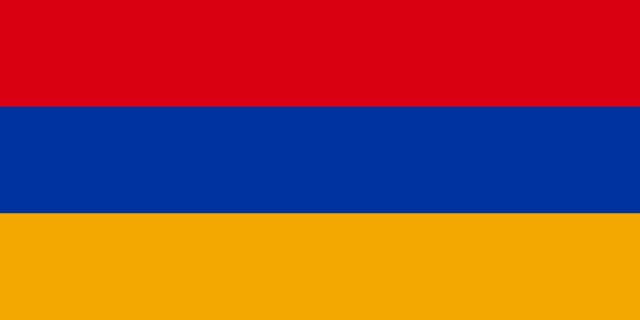
Flag of Armenia
🇦🇲
Flag Meaning
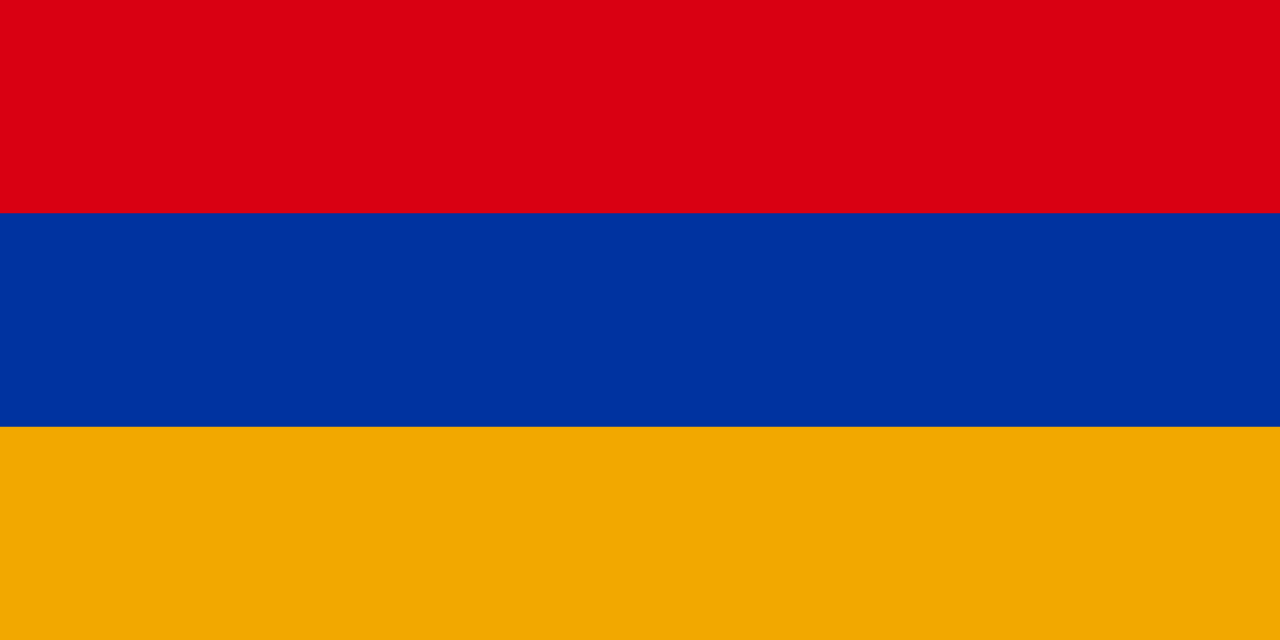
The national flag of Armenia is a horizontal tricolor featuring three equal bands of red, blue, and orange. This design serves as a powerful symbol of the nation's past resilience and its aspirations for a peaceful and productive future. It is often referred to as the Yeraguyn, which translates to tricolor in the Armenian language.
Colors & Symbols
The top red stripe represents the Armenian Highland and the continuous struggle of the people for survival and the maintenance of their Christian faith. The middle blue stripe signifies the will of the Armenian people to live under peaceful skies, while the bottom orange stripe represents the creative talent and diligent nature of the nation.
Adopted 1990
Proportions 1:2
Download

Country Statistics
Capital Yerevan
Population 3.1M
Region Asia
ISO-2 AM
Neighboring Flags
 AZE
AZE  GEO
GEO  IRN
IRN  TUR
TUR Flag History
The tricolor was originally used during the first republic of Armenia between 1918 and 1920 before the nation became part of the Soviet Union. Prior to this, a nineteenth century design by Ghevont Alishan featured different color schemes like red, green, and blue to represent a rainbow. The current design was officially restored as the national symbol in 1990 shortly before the country regained its full independence.
Frequently Asked Questions
Armenia's current flag was officially adopted on 1990.
Armenia's flag has an official proportion of 1:2.
Red stands for the highlands and survival, blue for peaceful skies, and orange for the hard-working nature of the people.
The official color is orange, though it is frequently described as the color of apricot, which is a national fruit and symbol of Armenia.
The modern flag uses a 1 to 2 ratio, whereas the version used during the early twentieth century featured a 2 to 3 proportion.
The tricolor design was proposed by the academician Stepan Malkhasyants during the period of the first republic.