
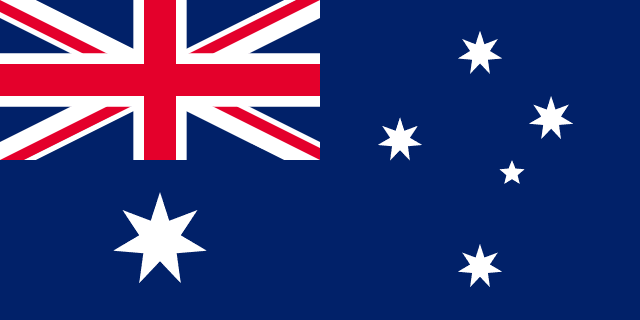
Flag of Australia
🇦🇺
Flag Meaning
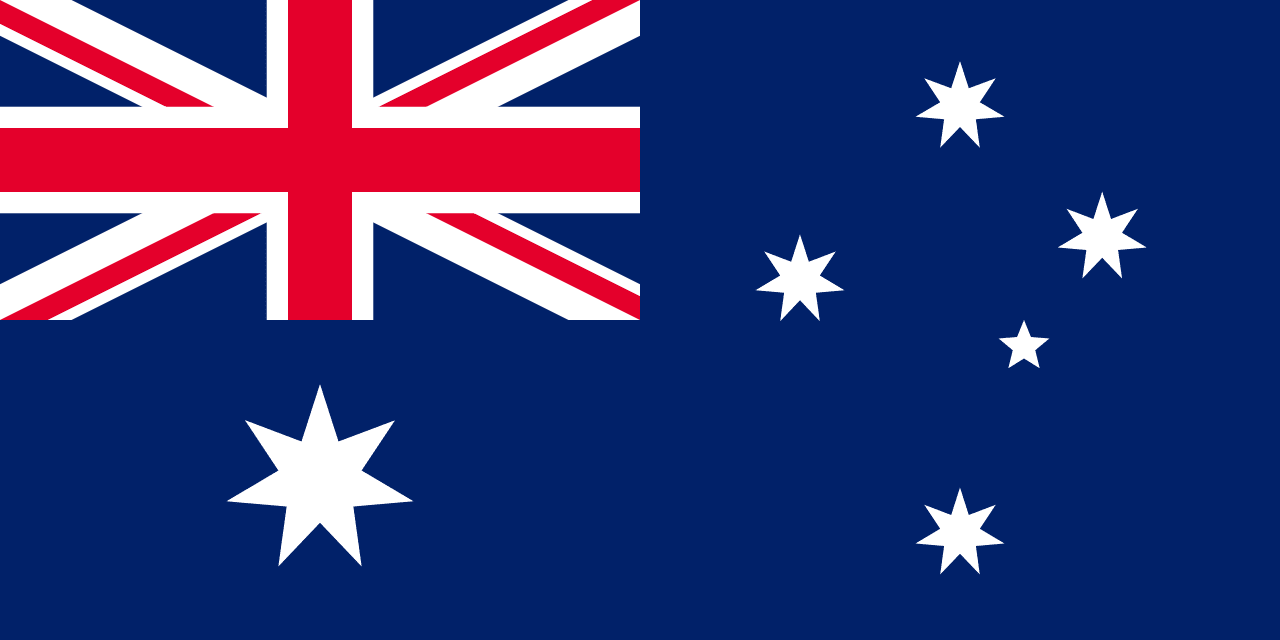
The flag of Australia is composed of three primary symbols: the Union Jack, the Commonwealth Star, and the Southern Cross constellation. The Union Jack in the upper hoist quadrant represents the historical links to Great Britain and the principles of parliamentary democracy. The large seven pointed star signifies the federation of the states and territories, while the five stars on the right represent the nation's unique geographical position in the Southern Hemisphere.
Colors & Symbols
The flag features a deep blue field that represents the surrounding oceans and the vast Australian sky. The stars are depicted in white to symbolize purity and the brightness of the night sky above the continent. Red and white elements within the Union Jack connect the national identity to its historical British foundations and traditional heraldry.
Adopted 1901
Proportions 1:2
Download


Country Statistics
Capital Canberra
Population 28M
Region Oceania
ISO-2 AU
Flag History
Following the federation of the colonies, a global competition was held in 1901 to design a national flag, attracting over 30,000 entries. Five separate winners who submitted nearly identical designs shared the prize money and were credited as the flag's creators. While the large Commonwealth Star originally had six points, a seventh point was added in 1908 to represent the various territories of the nation.
Frequently Asked Questions
Australia's current flag was officially adopted on 1901.
Australia's flag has an official proportion of 1:2.
The Southern Cross is a constellation visible from the Southern Hemisphere that represents Australia's location on the globe and its natural heritage.
Six points represent the original six states of the federation, while the seventh point represents the internal and external territories of the country.
The design was created by five different people who submitted nearly identical entries to a worldwide competition held at the time of federation.
The Union Jack symbolizes the history of British settlement in Australia and the shared legal and cultural heritage between the two nations.