
Flag of Belize
🇧🇿
Flag Meaning
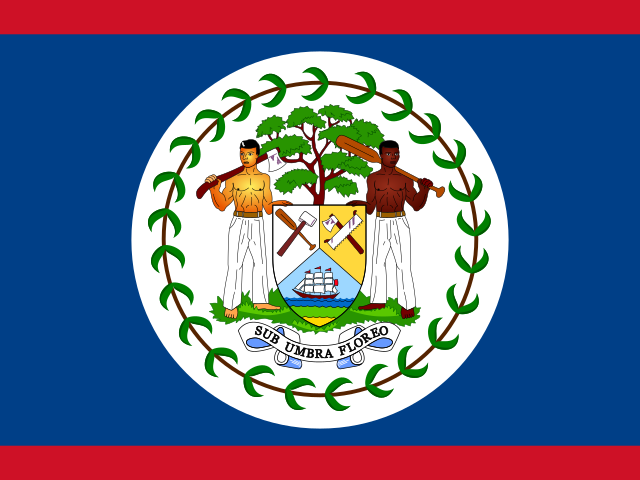
The flag of Belize serves as a detailed narrative of the country's history and its diverse population. At the center of a royal blue field lies a white disk containing the national coat of arms, which features two woodcutters and a mahogany tree. This emblem pays homage to the logging industry that laid the economic foundation of the nation while representing racial harmony and collaborative labor.
Colors & Symbols
The primary royal blue represents the People's United Party, while the two red stripes were added to represent the United Democratic Party, creating a bipartisan symbol of national unity. The white disk provides a clear background for the complex coat of arms and symbolizes a commitment to peace.
Adopted 1981
Proportions 3:5
Download
Country Statistics
Capital Belmopan
Population 417.6K
Region Americas
ISO-2 BZ
Neighboring Flags

Flag History
Based on the colonial emblem of British Honduras, the flag's design was refined over several decades before formal adoption. An unofficial version was used by independence advocates starting in 1950, and the final design added red stripes to ensure inclusivity of all political perspectives. It was officially hoisted for the first time on the day the country achieved full sovereignty.
Frequently Asked Questions
Belize's current flag was officially adopted on 1981.
Belize's flag has an official proportion of 3:5.
The motto Sub Umbra Floreo translates to Under the Shade I Flourish, highlighting the historical importance of the mahogany forests to the nation's growth.
Belize is unique for featuring two men on its flag, one of African descent and one of Mestizo descent, to symbolize the ethnic diversity and shared labor of its people.
The wreath contains fifty mahogany leaves, which commemorate the year 1950 as the beginning of the formal movement for national independence.
The red stripes were included to integrate the color of the opposition party, transforming the banner into a unified symbol for the entire country.