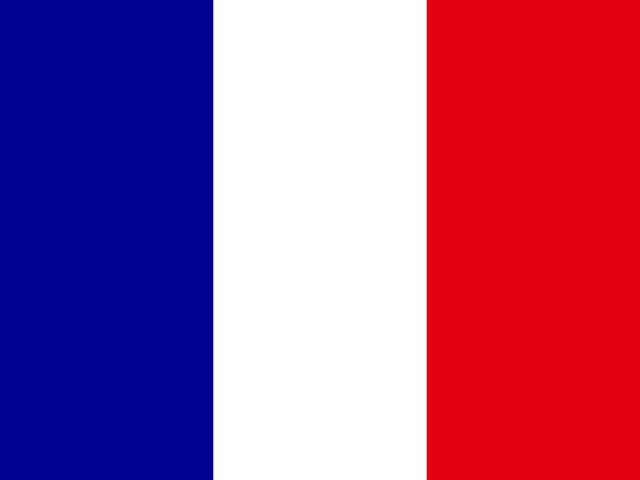
The flag of France, famously known as the Tricolour, serves as a powerful symbol of the nation revolutionary ideals of liberty, equality, and fraternity. Its design reflects a historical compromise, representing the unification of the French people and the end of absolute monarchical rule in favor of a republic.
Colors & Symbols
The blue and red vertical bands represent the traditional colors of Paris, associated with the city patron saints, Saint Martin and Saint Denis. The white band symbolizes the ancient monarchy or the House of Bourbon, intentionally placed between the colors of Paris to signify the reconciliation and union between the king and his subjects.
Before the revolution, the French flag was often a plain white standard or featured golden fleurs-de-lis on a blue field. The modern vertical tricolour was officially adopted in 1794 following a design by the artist Jacques-Louis David, though it was temporarily replaced by a white flag during the Bourbon Restoration until being permanently restored in 1830.
Frequently Asked Questions
France's current flag was officially adopted on 1794.
France's flag has an official proportion of 2:3.
The flag is most commonly referred to as the Tricolore or the Tricolour, highlighting its distinctive three-color vertical layout.
On land, the three stripes are of equal width, but the French Navy uses a variation where the blue, white, and red bands are proportioned 30:33:37 so they appear equal when fluttering in the wind.
The current vertical arrangement was designed by the celebrated neoclassical painter Jacques-Louis David during the French Revolution.
France has historically used both a dark navy blue and a lighter cobalt blue; the navy blue version was recently prioritized for official government use to reflect the original design from the revolutionary era.
🍪
Cookie Preferences
We use cookies to analyze traffic and improve your experience. No personal data is sold or shared with advertisers.
We use Google Analytics to understand how visitors use WorldStats. This helps us improve content and performance. Analytics cookies track page views and session data — no personally identifiable information is collected. You can change your preference at any time from the footer.