
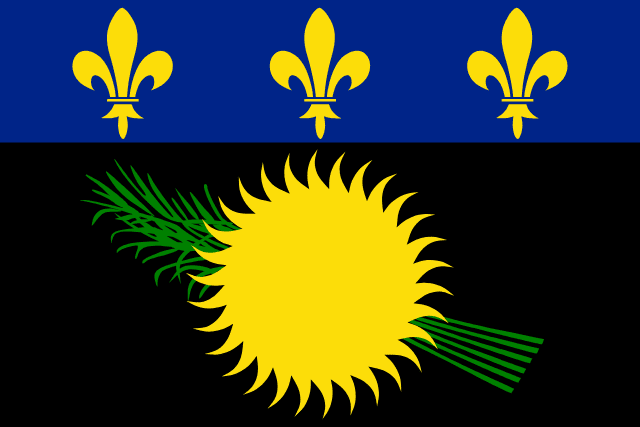
Flag of Guadeloupe
🇬🇵
Flag Meaning
As an overseas department of France, Guadeloupe officially uses the French Tricolor to symbolize its political integration and national values such as liberty and equality. An unofficial regional banner is frequently used for cultural and sporting events, featuring local symbols like a radiant sun and sugar cane. This regional emblem also includes fleurs-de-lis on a blue band, which acknowledges the territory's deep-rooted historical ties to France.
Colors & Symbols
The official flag consists of blue, white, and red vertical bands representing the French Republic. The unofficial regional flag uses a black or red field to represent heritage, a yellow sun for the tropical environment, and green for sugar cane crops. A blue stripe at the top contains yellow fleurs-de-lis, mirroring the traditional colors of the French monarchy.
Adopted 1794
Proportions 2:3
Download
Country Statistics
Capital Basse-Terre
Population 378.6K
Region Americas
ISO-2 GP
Flag History
Since the late eighteenth century, the French national flag has served as the official symbol for the archipelago. Over time, several local banners have emerged to express regional identity, including an unofficial flag based on the coat of arms of the capital city. Political movements have also introduced distinct designs, such as the striped flag used by independence groups, though the French Tricolor remains the only internationally recognized legal standard.
Frequently Asked Questions
Guadeloupe's current flag was officially adopted on 1794.
Guadeloupe's flag has an official proportion of 2:3.
No, as an overseas department of France, its only official flag is the French Tricolor.
It signifies the historical and economic importance of the sugar industry to the island's development.
They represent the historical connection to the French monarchy and the colonial history of the territory.
It symbolizes the tropical climate, energy, and life within the Caribbean archipelago.
Yes, a flag featuring the regional council's logo and a distinct independence flag with green, red, and yellow stripes are also used in various contexts.