
Flag of Israel
🇮🇱
Flag Meaning
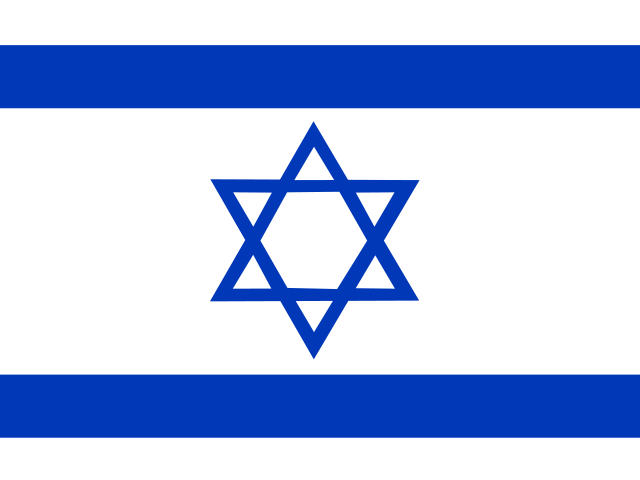
The flag of Israel features a central hexagram known as the Star of David positioned between two horizontal blue stripes on a white field. This design is primarily inspired by the tallit, the traditional Jewish prayer shawl, symbolizing the connection between the Jewish people and their religious heritage. The Star of David serves as a long standing emblem of Jewish identity and strength.
Colors & Symbols
The white background signifies purity and religious benevolence while the blue stripes represent the sky and the divine. The specific shade of blue is often associated with the biblical dye known as tekhelet, which held great significance in ancient Hebrew vestments. Together, these colors reflect the spiritual aspirations and the historical roots of the nation.
Adopted 1948
Proportions 8 to 11
Download
Country Statistics
Capital Jerusalem
Population 10M
Region Asia
ISO-2 IL
Neighboring Flags

Flag History
The current design was officially adopted shortly after the establishment of the state, though it originated decades earlier within the Zionist movement. It was first displayed in 1885 and later gained prominence at the First Zionist Congress in 1897. The design by David Wolffsohn was chosen over several other proposals, including one by Theodor Herzl that featured seven golden stars.
Frequently Asked Questions
Israel's current flag was officially adopted on 1948.
Israel's flag has an official proportion of 8 to 11.
The six pointed star in the center is called the Magen David, which is Hebrew for Shield of David.
The two horizontal blue stripes are inspired by the traditional Jewish prayer shawl known as the tallit.
White represents purity and divine benevolence, while blue symbolizes the glory of the heavens and the sky.
The design is widely attributed to David Wolffsohn, who modified earlier concepts to better reflect Jewish tradition.