
Flag of North Korea
🇰🇵
Flag Meaning
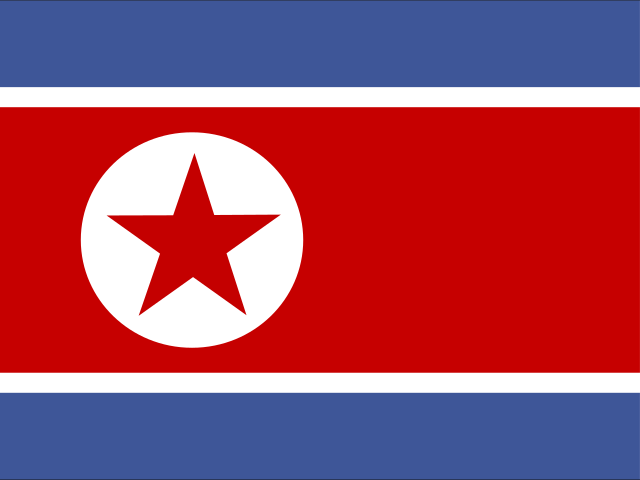
The flag of North Korea features a prominent red panel with a white circle containing a five-pointed red star, symbolizing the country's revolutionary socialist traditions and the bright future of its people. This design reflects the nation's commitment to progress and its historical struggle against imperialism. The star specifically represents the leading role of the ruling party and the spirit of the socialist revolution.
Colors & Symbols
The central red band represents the revolutionary spirit and the blood shed by patriots during the struggle for independence. The blue stripes symbolize sovereignty, peace, and international friendship, while the thin white stripes stand for the purity and homogeneity of the Korean nation. Together, these colors reflect a unified people working toward a common socialist goal.
Adopted 1948
Proportions 1:2
Download
Country Statistics
Capital Pyongyang
Population 26M
Region Asia
ISO-2 KP
Neighboring Flags

Flag History
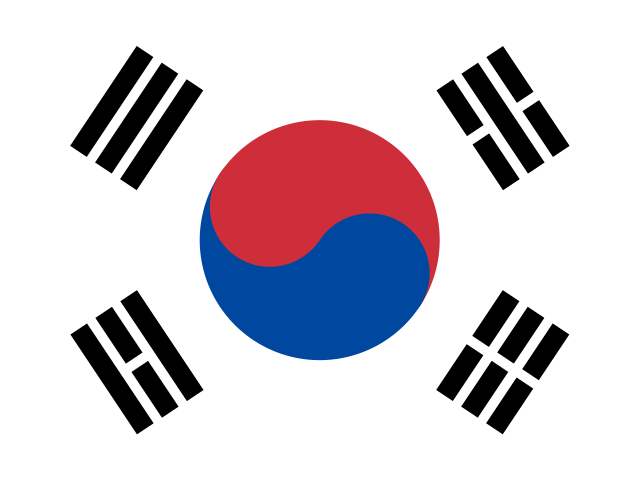
Following the liberation of the peninsula in 1945, the northern region initially used the traditional Taegukgi flag, which is characterized by its yin-yang symbol. The current design was officially adopted in September 1948 to distinguish the new republic and align its imagery with socialist and communist ideals. This transition was heavily influenced by the political shift toward a centralized socialist state under the guidance of early leadership.
Frequently Asked Questions
North Korea's current flag was officially adopted on 1948.
North Korea's flag has an official proportion of 1:2.
The red star is a universal symbol of communism and socialism, representing the revolutionary struggle and the leadership of the Korean Workers' Party.
The narrow white stripes symbolize the purity of the Korean nation and its long-standing cultural and ethnic homogeneity.
Prior to 1948, the region used the Taegukgi, which remains the basis for the current flag of South Korea and features ancient philosophical symbols.
Under the National Security Act, the public display of the North Korean flag is generally prohibited in South Korea, except during official international events or sporting competitions.