

Flag of Pakistan
🇵🇰
Flag Meaning
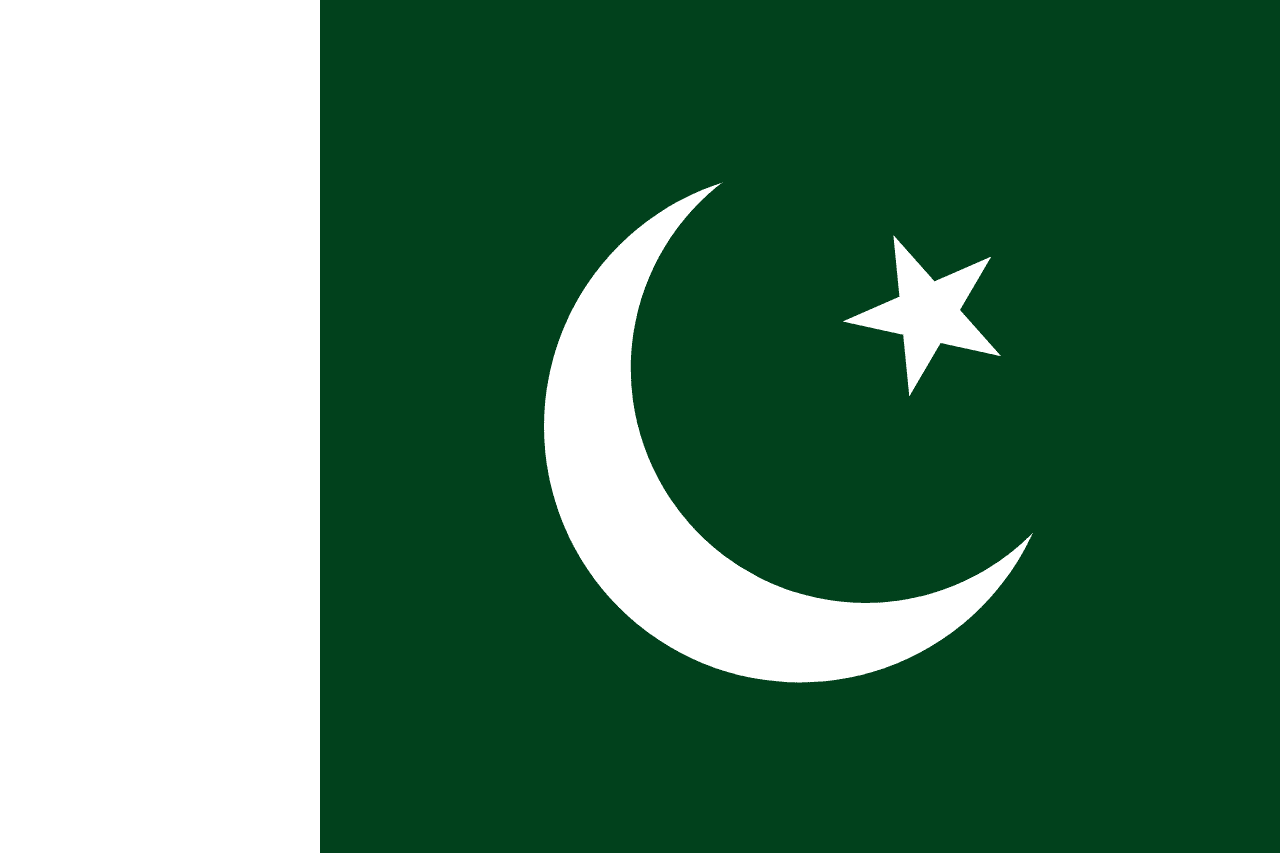
The flag of Pakistan represents the nation's identity as an Islamic republic while emphasizing its commitment to protecting the rights of religious minorities. The white crescent and five-pointed star serve as traditional symbols of progress and light, while the design as a whole reflects the country's aspirations for peace and prosperity. It is often referred to as the Flag of the Star and Crescent.
Colors & Symbols
The flag features two primary colors: dark green and white. The dark green field represents the Muslim majority and the religion of Islam, while the vertical white stripe at the hoist side symbolizes the religious minorities and their importance to the nation's harmony. Together, these colors represent a message of peace and mutual coexistence.
Adopted 1947
Proportions 2:3
Download

Country Statistics
Capital Islamabad
Population 241M
Region Asia
ISO-2 PK
Neighboring Flags
 AFG
AFG  CHN
CHN  IND
IND  IRN
IRN Flag History
The current design was created by Syed Amir-uddin Kedwaii and is based on the original flag of the All-India Muslim League. Before independence, a proposal by the British to include a small Union Jack in the corner was rejected by the nation's leadership to maintain a distinct identity. The flag was officially adopted by the Constituent Assembly just days before the country gained independence.
Frequently Asked Questions
Pakistan's current flag was officially adopted on 1947.
Pakistan's flag has an official proportion of 2:3.
The national flag was designed by Syed Amir-uddin Kedwaii, a prominent activist and member of the Muslim League.
The white crescent is a symbol of future progress, while the five-pointed star represents light, wisdom, and knowledge.
The white stripe was added to the original Muslim League design to represent the non-Muslim religious minorities living in the country, ensuring their recognition in the national symbol.
While the national design has remained the same since independence, a British colonial proposal featuring the Union Jack was famously rejected by Muhammad Ali Jinnah.