
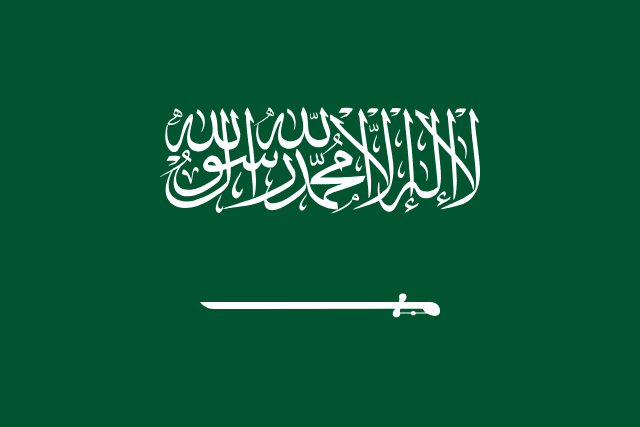
Flag of Saudi Arabia
🇸🇦
Flag Meaning
The flag of Saudi Arabia features the Shahada , or Islamic creed , written in white Thuluth script above a horizontal sword . This inscription represents the core tenets of Islam , while the sword symbolizes the strictness in applying justice and the military power used to protect the faith . The design serves as a powerful symbol of the Islamic heritage of the nation and its commitment to religious law .
Colors & Symbols
Green is the primary color of the flag , traditionally associated with the Prophet Muhammad and representing the Islamic faith . The white elements , including the Arabic calligraphy and the sword , signify peace and purity alongside the military strength of the kingdom . Together , these colors reflect the spiritual and physical foundation of the Saudi state .
Adopted 1973
Proportions 2 to 3
Download


Country Statistics
Capital Riyadh
Population 35M
Region Asia
ISO-2 SA
Neighboring Flags
 IRQ
IRQ  JOR
JOR  KWT
KWT  OMN
OMN  QAT
QAT  ARE
ARE  YEM
YEM Flag History
The flag evolved from the green banners used by the House of Saud during the eighteenth century . In the early twentieth century , a sword was added to the design to represent the unification of the kingdom which was completed in 1932 . The current design was officially standardized in 1973 to refine the proportions and the appearance of the sword and script .
Frequently Asked Questions
Saudi Arabia's current flag was officially adopted on 1973.
Saudi Arabia's flag has an official proportion of 2 to 3.
The flag contains the Shahada , which is the Islamic declaration of faith and the name of God , making it a sacrilegious act to lower it even during times of mourning .
The Arabic inscription is written in the Thuluth script , an elegant and traditional calligraphic style used for religious and formal documents .
The flag is manufactured with two identical sides sewn together to ensure the Shahada and the sword are correctly oriented from right to left on both the front and the back .
The sword symbolizes the House of Saud and the military strength used to defend the country and uphold justice according to Islamic law .