
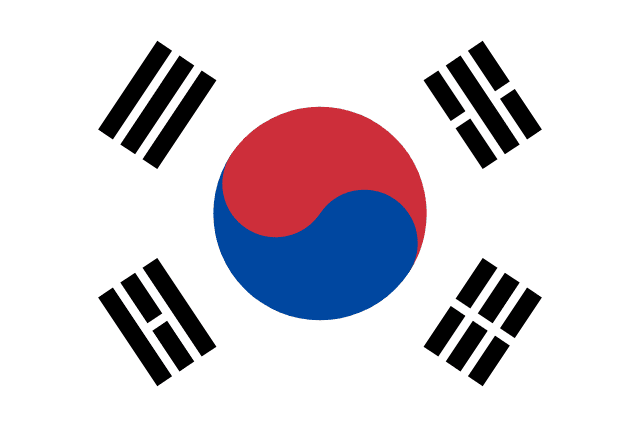
Flag of South Korea
🇰🇷
Flag Meaning
The flag of South Korea, known as the Taegeukgi, symbolizes the principles of balance and harmony in the universe. The central circle represents the origin of all things, while the surrounding trigrams signify the fundamental elements and movements of nature. It reflects the philosophical belief in the interconnectedness of all existence and the constant movement within the sphere of infinity.
Colors & Symbols
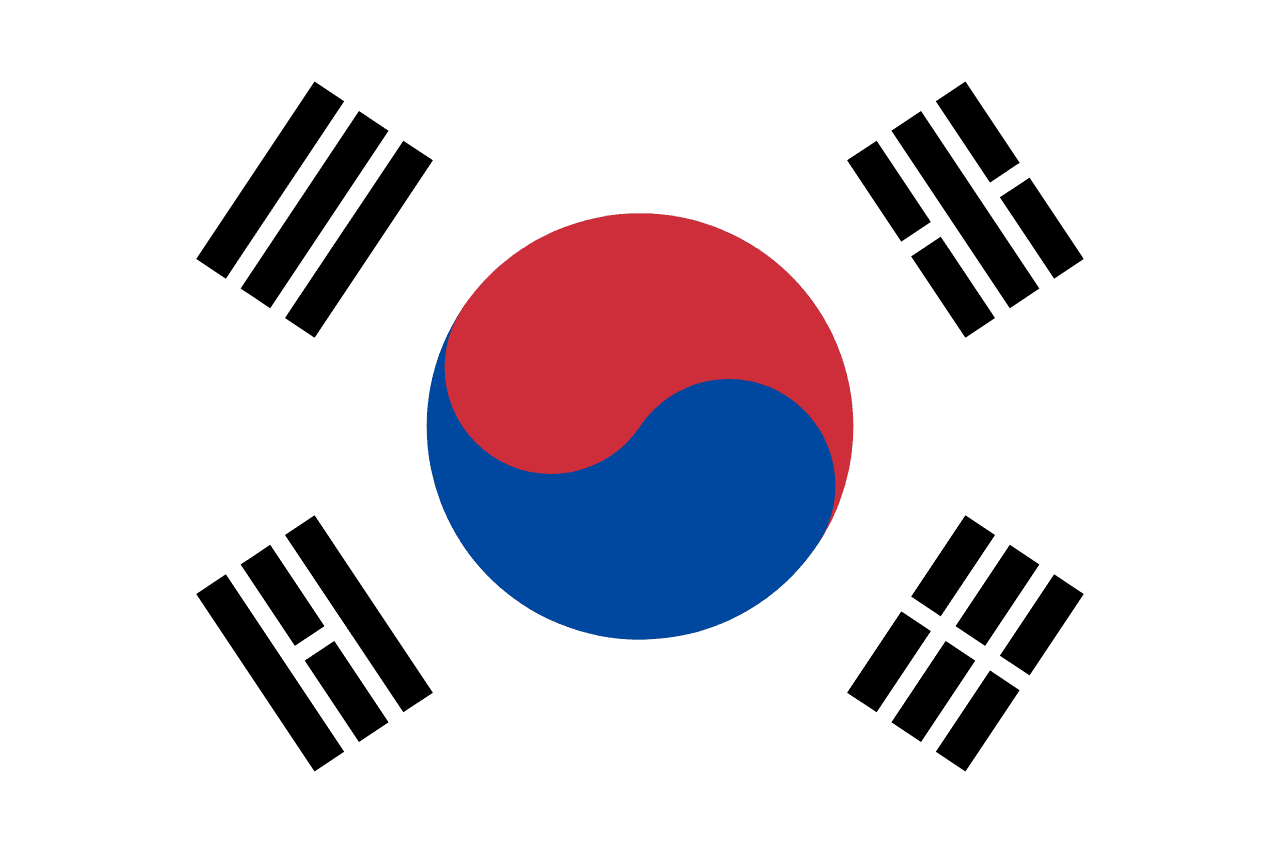
The white field is a traditional Korean color representing peace and the purity of the people. The central emblem contains red for positive cosmic forces and blue for negative cosmic forces, illustrating how opposing elements create a perfect whole. The four black trigrams signify justice and intelligence while providing a visual balance to the colorful central symbol.
Adopted 1949
Proportions 2:3
Download

Country Statistics
Capital Seoul
Population 51M
Region Asia
ISO-2 KR
Neighboring Flags
 PRK
PRK Flag History
The flag was first created in 1882 during the Joseon dynasty to represent Korean sovereignty during international negotiations. It was used by the provisional government during the period of foreign occupation before being officially standardized for the Republic of Korea in 1949. Modern updates in recent years have specifically defined the exact shades of red and blue to ensure consistent production.
Frequently Asked Questions
South Korea's current flag was officially adopted on 1949.
South Korea's flag has an official proportion of 2:3.
The four trigrams represent the sky, earth, water, and fire, as well as the four cardinal directions and the four seasons.
It translates to the flag of the supreme ultimate, signifying the source and the perfect balance of the entire universe.
White is the traditional color of the Korean people, symbolizing their historical identity as a nation of peace and their commitment to purity.
No, while North Korea used a version of the Taegeukgi briefly after liberation, the country adopted its own distinct national flag design in 1948.