
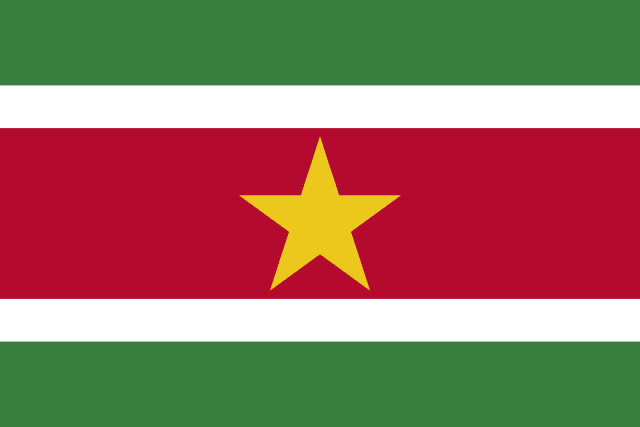
Flag of Suriname
🇸🇷
Flag Meaning
The flag of Suriname is a powerful symbol of national unity and the collective hope for a prosperous future. The central star represents the togetherness of the nation's diverse ethnic groups, while the horizontal bands reflect the journey of the people toward sovereignty and social justice.
Colors & Symbols
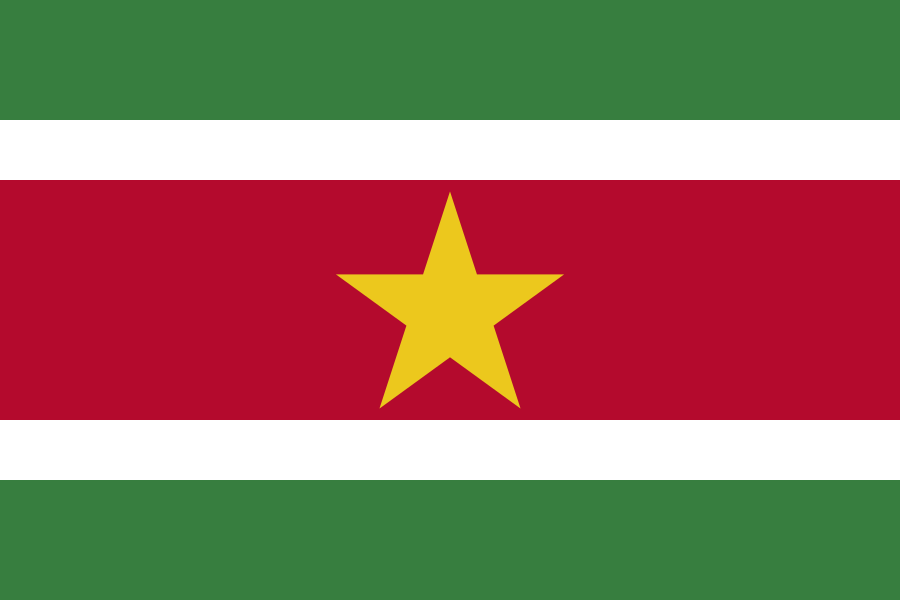
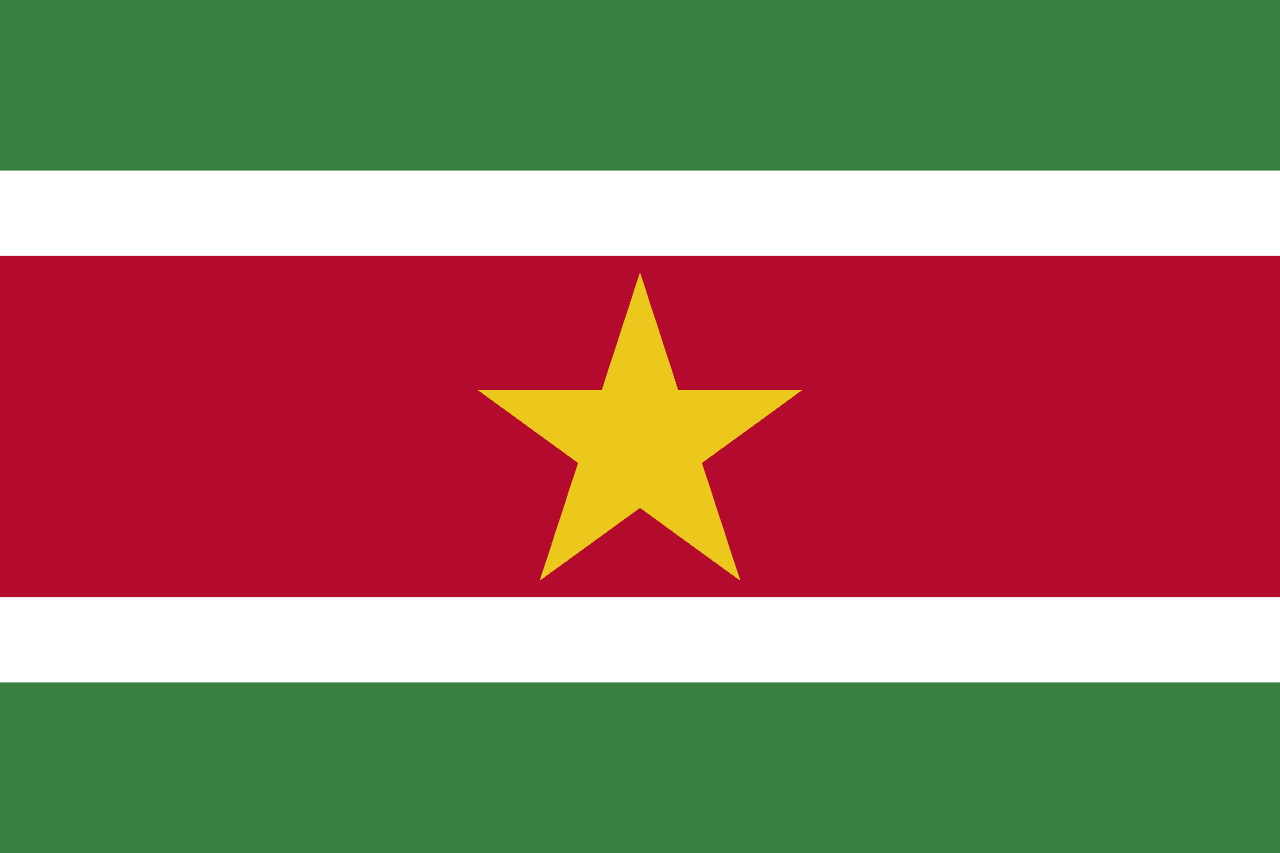
Green represents the fertility of the tropical landscape and the hope for a vibrant national future. White signifies justice, freedom, and peace, while red denotes progress and the love and sacrifices made by the people. The yellow star stands for unity and the inspiration drawn from a shared golden future.
Adopted 1975
Proportions 2:3
Download
Country Statistics
Capital Paramaribo
Population 616.5K
Region Americas
ISO-2 SR
Neighboring Flags
 BRA
BRA  GUF GUY
 Flag History
Prior to independence, the nation used a flag with five different colored stars on a white field to represent its various ethnic populations. The current design was selected following a national competition and was officially hoisted for the first time on the day the country gained independence from the Netherlands. This transition marked a shift from colonial symbolism to a design that emphasized a unified national identity.
Frequently Asked Questions
Suriname's current flag was officially adopted on 1975.
Suriname's flag has an official proportion of 2:3.
The yellow star symbolizes the unity of the different ethnic groups within the country and their shared hope for a bright and golden future.
The current flag was officially adopted on November 25, 1975, the same day the nation achieved its independence.
The flag was designed by Jack Pinas, an artist who won a national competition held to create a new symbol for the independent republic.
The red stripe represents progress and the love of the people for their country, as well as the struggle for a better life.