
Flag of United States
🇺🇸
Flag Meaning
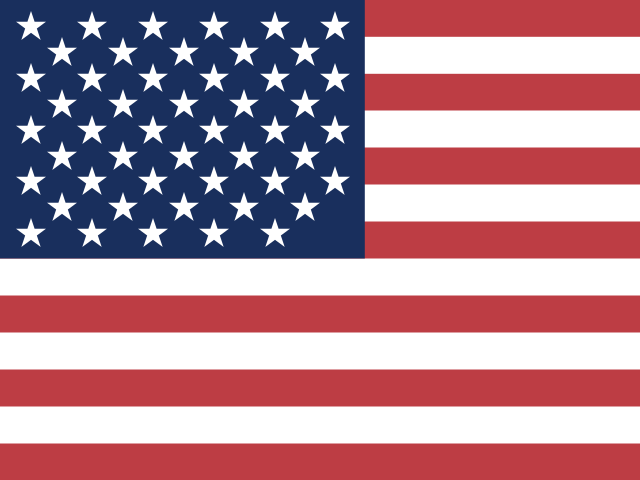
The flag of the United States serves as a prominent symbol of the nation's unity and its founding history. The fifty white stars on the blue field represent each individual state in the union, while the thirteen horizontal stripes honor the original colonies that declared independence. This design reflects the growth of the country from its beginnings into a large federation of states.
Colors & Symbols
The colors used in the flag were chosen to reflect specific national values. Red represents hardiness and valor, signifying the strength and courage of the people. White symbolizes purity and innocence, while the blue section, known as the union, represents vigilance, perseverance, and justice.
Adopted 1960
Proportions 10:19
Download
Country Statistics
Capital Washington, D.C.
Population 340M
Region Americas
ISO-2 US
Neighboring Flags

Flag History
Since its first official authorization in 1777, the national flag has evolved through twenty seven different versions to account for the admission of new states. The original design featured thirteen stars in various patterns, such as a circle or a simple grid. The current fifty star arrangement was famously created by a seventeen year old student named Robert G. Heft for a school assignment before being officially selected by the government.
Frequently Asked Questions
United States's current flag was officially adopted on 1960.
United States's flag has an official proportion of 10:19.
The thirteen horizontal stripes represent the original thirteen colonies that formed the foundation of the United States.
The current fifty star design was created by Robert G. Heft, who originally submitted the design as a high school history project in 1958.
The flag is frequently referred to by several nicknames, including the Stars and Stripes, Old Glory, and the Star Spangled Banner.
The blue rectangular area is called the union because it contains the stars that symbolize the collective unity of all the individual states.