
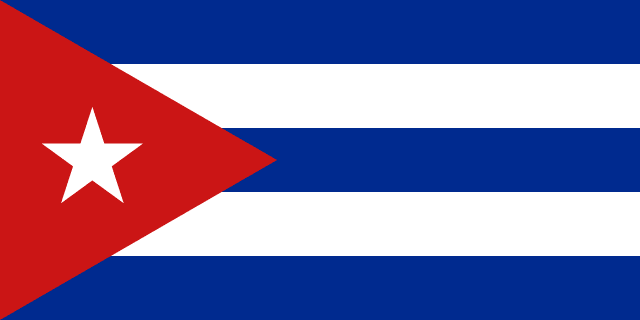
Flag of Cuba
🇨🇺
Flag Meaning
The flag of Cuba features three blue horizontal stripes representing the original three military districts of the island: Occidental, Central, and Oriental. Two white stripes signify the purity of the patriot cause, while the red triangle serves as a Masonic symbol for liberty, equality, and fraternity. At the center of the triangle, a white star known as the Lone Star represents independence and absolute freedom.
Colors & Symbols
The indigo blue stripes denote the historical administrative divisions, while the white stripes represent the purity and strength of the independence movement. The red of the triangle commemorates the blood shed by heroes who fought for national sovereignty.
Adopted 1902
Proportions 1:2
Download
Country Statistics
Capital Havana
Population 9.7M
Region Americas
ISO-2 CU
Flag History
General Narciso Lopez and poet Miguel Teurbe Tolon designed the flag in 1849 during their exile in New York City. It was first hoisted in the city of Cardenas in 1850 during an early attempt to liberate the country from colonial rule. The design was officially confirmed as the national emblem when the republic was established at the beginning of the twentieth century.
Frequently Asked Questions
Cuba's current flag was officially adopted on 1902.
Cuba's flag has an official proportion of 1:2.
Known as La Estrella Solitaria, the star symbolizes the independent and sovereign nature of the nation.
The first flag was sewn by Emilia Teurbe Tolon, who was the wife of the designer Miguel Teurbe Tolon.
The triangle is a Masonic symbol for equality and also signifies the blood sacrificed by patriots during the wars for independence.
The flag of Puerto Rico uses an identical design but with the colors of the stripes and triangle reversed to symbolize shared historical ties.