
Flag of Equatorial Guinea
🇬🇶
Flag Meaning
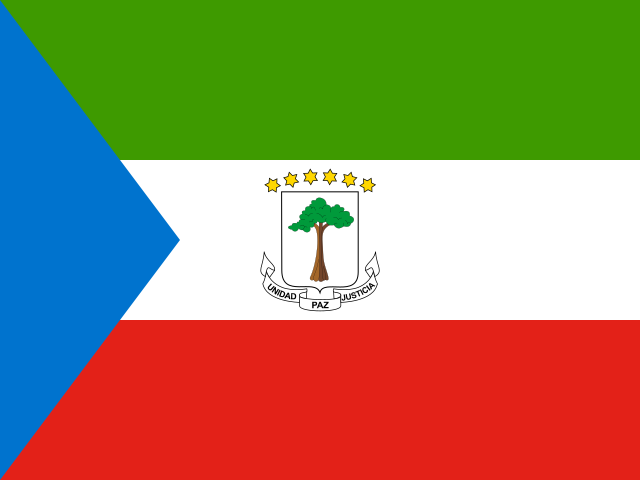
The flag symbolizes the geographical and political unity of the nation and its five principal islands. The central coat of arms features a silver shield with a silk cotton tree which has deep historical roots as the site where the first treaty with Spain was signed. Above the shield six golden stars represent the different territories that constitute the Republic of Equatorial Guinea.
Colors & Symbols
Green represents the lush vegetation jungles and natural resources of the nation. White signifies peace and harmony while red honors the blood shed by those who fought for the independence of the country. The blue triangle at the hoist represents the Atlantic Ocean that connects the mainland to the offshore islands.
Adopted 1968 with restoration in 1979
Proportions 2 to 3
Download
Country Statistics
Capital Ciudad de la Paz
Population 1.7M
Region Africa
ISO-2 GQ
Neighboring Flags

Flag History
The flag was first introduced on the day of independence in 1968 though many early versions lacked the coat of arms due to manufacturing delays. During the regime of Francisco Macias Nguema in the mid 1970s the national emblem was briefly replaced with a design featuring agricultural tools and a cockerel. The original symbols and the motto were restored in 1979 to reaffirm the founding principles of unity and justice.
Frequently Asked Questions
Equatorial Guinea's current flag was officially adopted on 1968 with restoration in 1979.
Equatorial Guinea's flag has an official proportion of 2 to 3.
The tree is a silk cotton tree or Ceiba which marks the historical location where a treaty between Spain and a local ruler was signed.
The six yellow stars represent the mainland territory of Rio Muni and the five islands of Bioko Annobon Corisco Elobey Grande and Elobey Chico.
The motto is Unidad Paz Justicia which translates from Spanish to English as Unity Peace Justice.