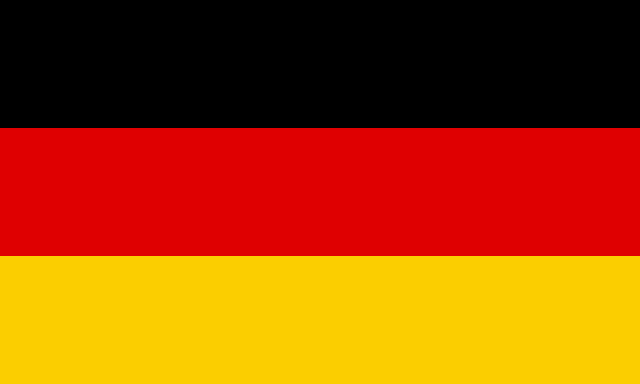
The flag of Germany is a horizontal tricolor featuring the colors black, red, and gold, which serve as symbols of modern democracy and republican freedom. Historically, these colors represent the movement for a unified German state and are often interpreted as a journey from the darkness of servitude through bloody conflict into the light of liberty. Today, the flag stands as a unifying emblem for the federal republic and its commitment to constitutional order.
Colors & Symbols
The black stripe represents determination and the historical struggle for independence, often linked to the uniforms of nineteenth-century volunteer fighters. The red stripe symbolizes bravery and the blood shed during the quest for national unity and democratic reform. The gold stripe, which is heraldically described as gold but often appears as a deep yellow, signifies the brightness of freedom and the wealth of a prosperous future.
The black, red, and gold tricolor first gained national prominence during the 1848 revolutions and was later used by the Weimar Republic starting in 1919. During the era of the German Empire from 1871 to 1918, the nation utilized a black, white, and red flag, which was later replaced by the current design after World War I and again after World War II. While East Germany and West Germany initially shared the same tricolor after 1949, East Germany added a socialist coat of arms to its version in 1959 before the nation reunified under the plain tricolor.
Frequently Asked Questions
Germany's current flag was officially adopted on 1949.
Germany's flag has an official proportion of 3:5.
The official designation for the bottom stripe is gold, although in many print and digital formats, it is represented by a shade of yellow to maintain visibility and contrast.
The colors are widely believed to have originated from the black uniforms with red facings and gold buttons worn by the Lützow Free Corps during the Napoleonic Wars.
The standard national flag is a plain tricolor, but the federal government uses a version known as the state flag that includes a central shield featuring a black eagle on a gold background.
The current official ratio is 3:5, whereas the version used during the Weimar Republic era traditionally used a 2:3 proportion.
While the design was adopted by West Germany in 1949, it became the official flag of the reunified German state on October 3, 1990.
🍪
Cookie Preferences
We use cookies to analyze traffic and improve your experience. No personal data is sold or shared with advertisers.
We use Google Analytics to understand how visitors use WorldStats. This helps us improve content and performance. Analytics cookies track page views and session data — no personally identifiable information is collected. You can change your preference at any time from the footer.



 AUT
AUT  BEL
BEL  CZE
CZE  DNK
DNK  FRA
FRA  LUX
LUX  NLD
NLD  POL
POL  CHE
CHE