
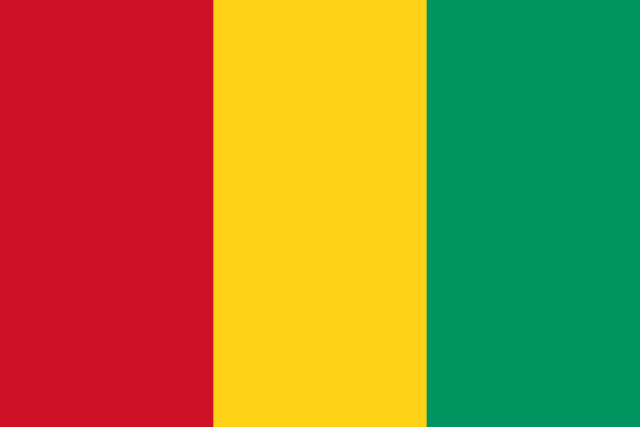
Flag of Guinea
🇬🇳
Flag Meaning
The flag of Guinea is a vertical tricolor that serves as a powerful symbol of national sovereignty and the Pan-African movement. It was designed to represent the three pillars of the national motto: Work, Justice, and Solidarity. The vertical stripe format was intentionally chosen to mirror the French Tricolor, representing the country's transition from a colonial territory to a modern independent state.
Colors & Symbols
Red represents the blood of martyrs shed during the struggle for freedom and the value of hard work. Yellow symbolizes the radiant sun and the vast mineral wealth of the land, specifically gold, while representing the ideal of justice. Green signifies the lush tropical vegetation of the country and the importance of agriculture as a foundation for prosperity and hope.
Adopted 1958
Proportions 2:3
Download

Country Statistics
Capital Conakry
Population 14M
Region Africa
ISO-2 GN
Neighboring Flags
 CIV
CIV  GNB
GNB  LBR
LBR  MLI
MLI  SEN
SEN  SLE
SLE Flag History
Upon gaining independence from France in 1958, Guinea became the first former French colony in Sub-Saharan Africa to adopt a national flag featuring Pan-African colors. The design was influenced by the political movement of the era and the flag of Ghana, which had recently achieved independence. While the layout reflects European traditions, the specific color palette was a deliberate statement of African unity and self-determination.
Frequently Asked Questions
Guinea's current flag was officially adopted on 1958.
Guinea's flag has an official proportion of 2:3.
The two flags use the same colors in a vertical tricolor format, but the order is reversed; Guinea's flag begins with red at the hoist, whereas Mali's flag begins with green.
The national flag of Guinea is a plain tricolor with three equal vertical stripes and does not contain any additional symbols, stars, or coats of arms.
The vertical orientation was adopted to reflect the design of the French flag, acknowledging the administrative structure of the previous era while the new colors asserted a fresh national identity.