
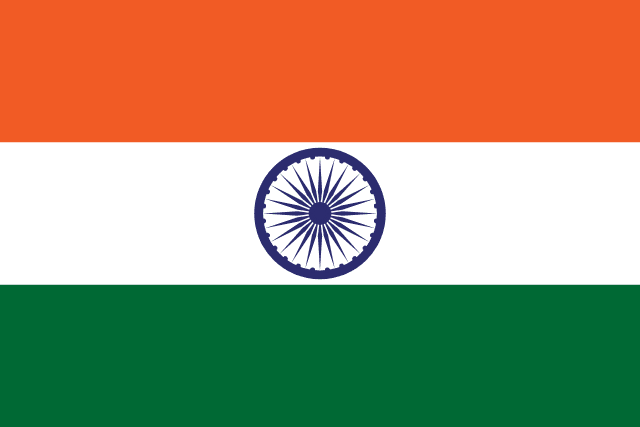
Flag of India
🇮🇳
Flag Meaning
The flag of India, known as the Tiranga, is a symbol of national pride and a free country. It represents the hopes and aspirations of the Indian people through its balanced design and historic symbols. The central wheel signifies the eternal laws of righteousness and the progressive movement of the nation.
Colors & Symbols
Saffron indicates strength and courage, while the white band signifies peace and truth. The green band represents the fertility, growth, and auspiciousness of the land. In the center, a navy blue Ashoka Chakra with twenty four spokes illustrates the wheel of dharma and the importance of constant movement.
Adopted 1947
Proportions 2 : 3
Download

Country Statistics
Capital New Delhi
Population 1B
Region Asia
ISO-2 IN
Neighboring Flags
 BGD
BGD  BTN
BTN  MMR
MMR  CHN
CHN  NPL
NPL  PAK
PAK Flag History
The flag is based on the Swaraj design proposed by Pingali Venkayya, which originally featured a spinning wheel to symbolize self reliance. Over several decades, the colors and symbols evolved to be more inclusive of all communities and spiritual values. In July 1947, the spinning wheel was replaced by the Ashoka Chakra from the Sarnath Lion Capital to finalize the current version.
Frequently Asked Questions
India's current flag was officially adopted on 1947.
India's flag has an official proportion of 2 : 3.
The twenty four spokes represent the twenty four hours of the day and serve as a reminder of the constant movement of the nation and the tireless pursuit of progress.
Pingali Venkayya, a freedom fighter and agriculturist, is the primary designer who created the early versions that led to the modern tricolor.
The change was made to represent the wheel of law and ancient heritage while making the design more universally acceptable across various political and social groups.
The navy blue color represents the sky and the ocean, symbolizing the universal truth and the vastness of the vision of the nation.