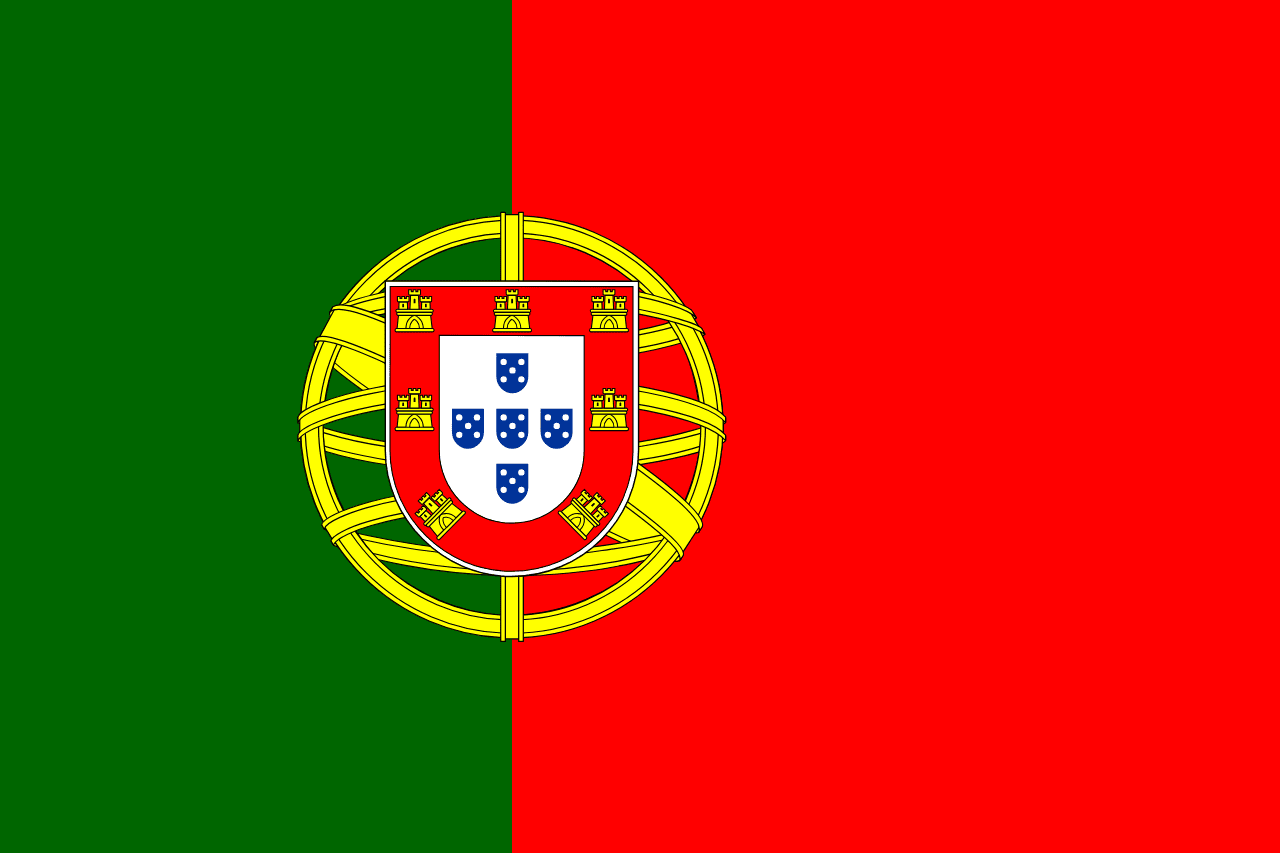
The flag of Portugal represents the nation's republican values and its legendary maritime history during the Age of Discovery. The central emblem combines an armillary sphere, which symbolizes navigation and global exploration, with a traditional shield that traces the country's medieval roots. Within the shield, five blue escutcheons commemorate historical military victories, while the seven golden castles signify the fortresses recaptured during the expansion of the kingdom.
Colors & Symbols
The flag features two primary colors, with green representing hope for the future and the revolutionary movement that established the republic. Red symbolizes the blood and sacrifice of the Portuguese people who fought for their country and its independence. These colors were chosen to replace the traditional blue and white of the monarchy, marking a clear break from the previous regime.
The current design was created following the revolution of October 1910, which ended centuries of monarchist rule. Before this, the flag was predominantly blue and white, colors that had been used in various forms since the founding of the nation. A special commission including prominent artists and writers was appointed to create the new national symbol, which was officially sanctioned in 1911.
Frequently Asked Questions
Portugal's current flag was officially adopted on 1911.
Portugal's flag has an official proportion of 2:3.
It is a navigational instrument used by Portuguese explorers during the Age of Discovery to chart the oceans and discover new lands.
Known as the quinas, they represent the five Moorish kings defeated by King Afonso Henriques at the Battle of Ourique.
Green was the color of the Portuguese Republican Party and was used to symbolize hope and the dawn of a new era after the fall of the monarchy.
They represent the fortresses conquered from the Moors by King Afonso III during the completion of the Portuguese Reconquista.
No, the flag is divided vertically so that the green section takes up two-fifths of the length and the red section takes up the remaining three-fifths.
🍪
Cookie Preferences
We use cookies to analyze traffic and improve your experience. No personal data is sold or shared with advertisers.
We use Google Analytics to understand how visitors use WorldStats. This helps us improve content and performance. Analytics cookies track page views and session data — no personally identifiable information is collected. You can change your preference at any time from the footer.


 ESP
ESP